Hardware

DineStack on hardware that looks as good as it works

DineStack runs on supported Android hardware, so you can use your own devices or follow our recommended counter setup. The product is the software and the operating model — not a locked terminal.

  • Bring your own supported hardware or follow a recommended setup.
  • A large touchscreen counter experience built for fast service.
  • Wi-Fi-first, with fewer cables and easier placement on a counter.
  • Kitchen, POS and operations screens all run under one DineStack system.

Concept render

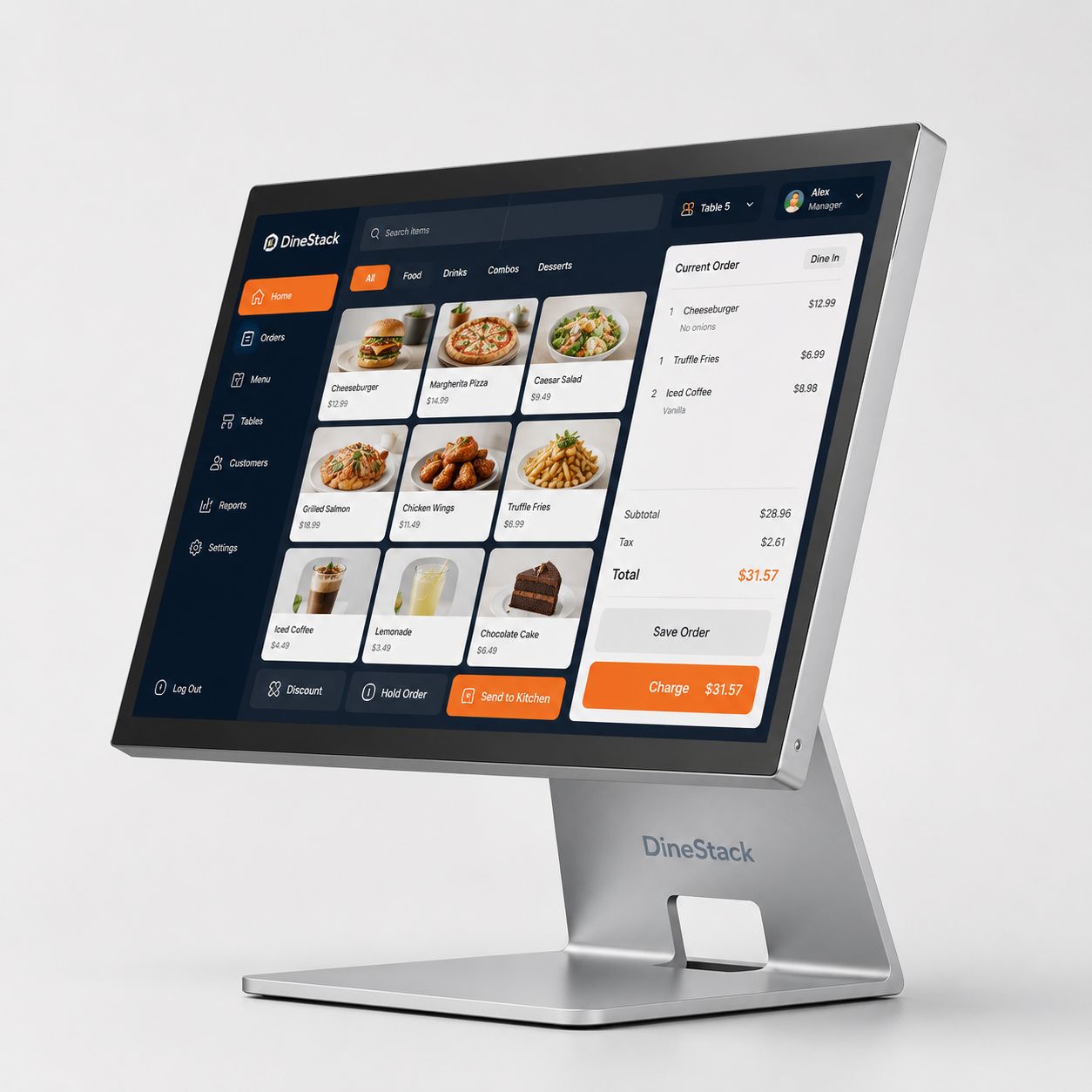
A concept render of a DineStack counter setup: a large touchscreen terminal on a stand, showing an order being built on the left and the running order total with a charge button on the right.
Concept render of a DineStack-branded counter setup. DineStack currently runs on supported third-party hardware, and the interface shown is illustrative rather than a capture of the shipping build.

What you need

Seven pieces, and you already own most of them

No model list and no prices. A list like that is out of date within a season, and we would rather not be the reason you bought the wrong thing.

Required

POS tablet

An Android tablet with Google services. One at the counter is enough; up to six per location.

Where from
Anywhere you buy tablets.

Optional

Kitchen screen

The same kind of tablet, in kitchen mode. A busy counter can also run one tablet in both modes.

Where from
Anywhere.

From your provider

Card reader

A Bluetooth reader paired to the tablet. In Canada, one with chip and PIN for Interac.

Where from
Your payment provider ships it to the restaurant, at their price.

No hardware

Tap to pay

Where the tablet or phone has NFC, cards can be taken on the device itself with no reader at all.

Where from
Nothing to buy.

Bring your own

Backup terminal

Any independent card terminal — the one from your bank is fine. It does not talk to DineStack; you take the payment on it and record what happened.

Where from
You probably already have one.

Not yet

Receipt printer

The receipt itself and the print queue are built; the driver that talks to a physical printer is not. Many counter restaurants no longer print at all.

Where from
Anywhere, once that driver lands.

If you deliver

Driver phone

An Android phone, if you run your own delivery. The driver’s own phone is fine.

Where from
Nothing to buy.
Ask us what we have actually tested on and we will tell you what we know, rather than publishing a compatibility list nobody maintains.

Certification

Where hardware certification stands

We will not tell you something is certified when it has not been proven on a physical device. This is the whole list, including the parts that are not there yet.

POS on an Android tablet
Proven on real hardware, including the local database, offline operation and recovery from being killed mid-service.
Card reader
Card payments run through Stripe Terminal. The server side is live-verified; the reader itself has not yet been certified on our hardware.
Driver Android app
Delivery is software-certified; it has not yet been run through a driver-phone certification.
Backup terminal
Recording a payment taken on an independent terminal is built and tested; no physical backup terminal has been run end to end yet.
Receipt printer
Receipt formatting and the print queue are built; the ESC/POS driver is not. It lands when there is a physical printer to verify it against.

Setup

Adding a device takes a code and a minute

Stage 1

Add a terminal

In the owner dashboard. It gives you a short setup code.

Stage 2

Type it into the tablet

That is the whole process, and it is the same one for a POS, a kitchen screen or a driver phone.

Stage 3

The code expires

Good for fifteen minutes, and for one device.

Stage 4

Losing one costs one

Every terminal ends up with its own credential, so losing a tablet means revoking that tablet — not re-provisioning the restaurant. Everything it already recorded stays exactly where it was.

Get started